The Claim that Earth Is Getting Temporary ‘Second Moon’ Stretches the Truth
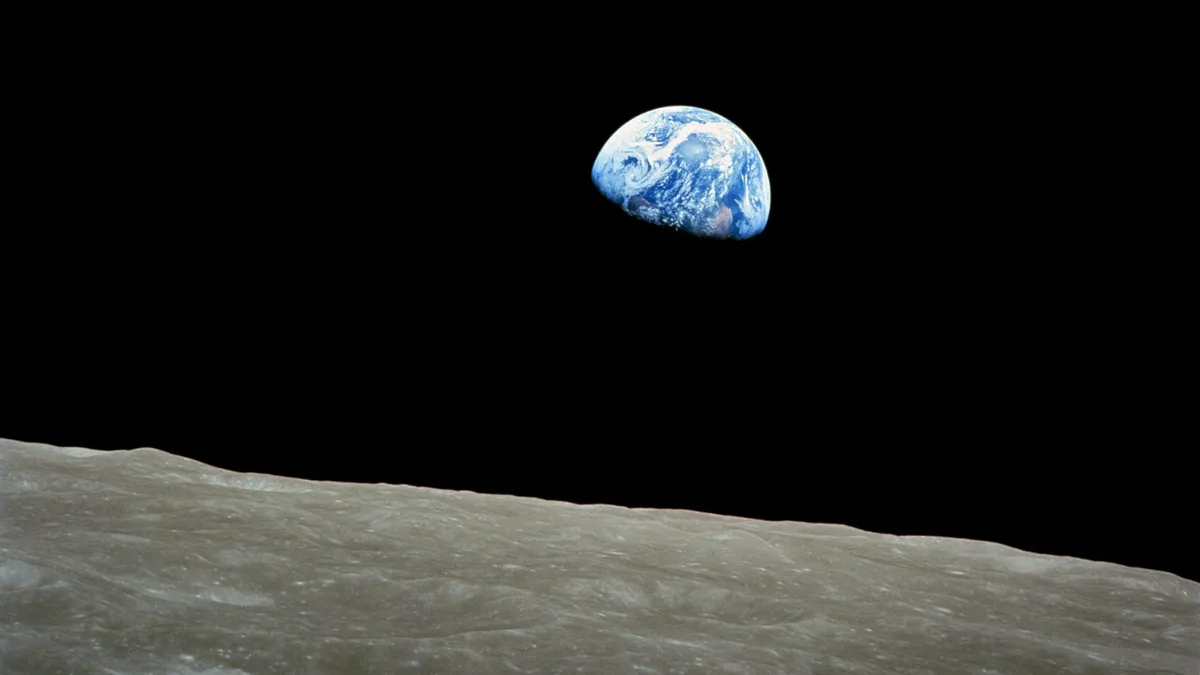
Rumors that Earth had picked up a new companion in the form of a so-called “second moon” began spreading online in late December 2025 and continued to light up social media into the new year.
Amateur astronomers took to social media platforms such as X to share their excitement over the purported discovery, with some users claiming that NASA “has confirmed that Earth will temporarily have a ‘second moon.'”
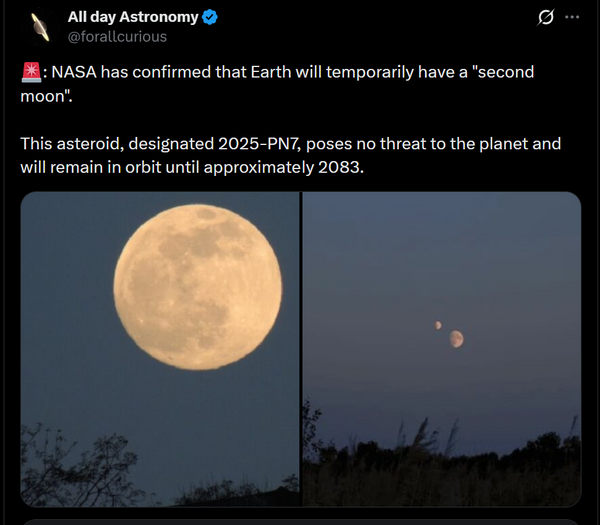
(@forallcurious via X)
It is true that astronomers discovered “a relatively short-lived quasi-satellite of Earth” and dubbed it 2025 PN7, according to a paper published by the American Astronomical Society in September 2025, which also mentioned the existence of six other known quasi-satellites, also called “quasi-moons,” currently orbiting alongside Earth.
The Pan-STARRS observatory in Hawaii first clocked 2025 PN7 on Aug. 2, 2025. Major news outlets, including CNN, ABC News, Yahoo, Smithsonian Magazine, The New York Times and Northeastern University’s Northeastern Global News, also reported the discovery.
It would be misleading to call 2025 PN7 a “second moon,” however, and there is no evidence that NASA “confirmed” as much, despite social media posts’ claims. 2025 PN7 was searchable through NASA’s Small-Body Database Lookup, which displayed scientific data of the object.
According to NASA, that 2025 PN7 is an asteroid and a “quasi-moon,” and explained how these objects differ from true moons. “Unlike a moon a quasi-moon is not gravitationally bound to Earth but follows an orbit around the Sun that makes it linger near Earth for an extended period of time,” the NASA spokesperson said.
In other words, quasi-moons orbit the Sun, while moons orbit a planet — like Earth’s moon. Therefore, claims that 2025 PN7 is a “second moon” are misleading.
The paper published by AAS added, “Quasi-satellites are in a resonant orbit but are not gravitationally bound to Earth, allowing for more sustained, though unbound, proximity; while mini-moons are characterized by temporary gravitational captures by Earth, meaning they are gravitationally bound, albeit for a limited time.”
The length of time for which the asteroid has been in step with Earth’s orbit did not appear in the NASA database nor the AAS paper, but NASA said, “2025 PN7 has been in this configuration since at least the past 70 years and will remain so for another 60 years.”
NASA’s timeline matched the information in a New York Times report, which included an interview with Carlos de la Fuente Marcos, a researcher at Complutense University of Madrid and co-author of the AAS paper. The Times wrote that 2025 PN7 “seems to have shifted into its quasi-moon orbit in 1957 — just in time to witness the launch of Sputnik 1, Earth’s first artificial satellite.” The report also suggested that 2025 PN7 would be in step with Earth’s orbit for another 60 years before moving elsewhere.
“These asteroids are relatively easy to access for unmanned missions and can be used to test planetary exploration technologies with a relatively modest investment,” CNN quoted de la Fuente Marcos as saying, emphasizing the importance of such a discovery.
But readers can rest easy knowing astronomers also confirmed that 2025 PN7 — and quasi-satellites in general — pose no threat to Earth. According to de la Fuente Marcos, the closest distance to Earth 2025 PN7 reached during its orbit was 186,000 miles.
For comparison, the Moon is “an average of 238,855 miles” from Earth, according to NASA.
The claim “As of late 2025, NASA had confirmed the existence of a temporary second moon that would remain in orbit next to Earth until 2083”.
In sum, it is true that astronomers discovered a quasi-satellite, or “quasi-moon,” that will keep pace with Earth’s orbit for the next 60 years or so, but calling it a “second moon” is misleading at best.